


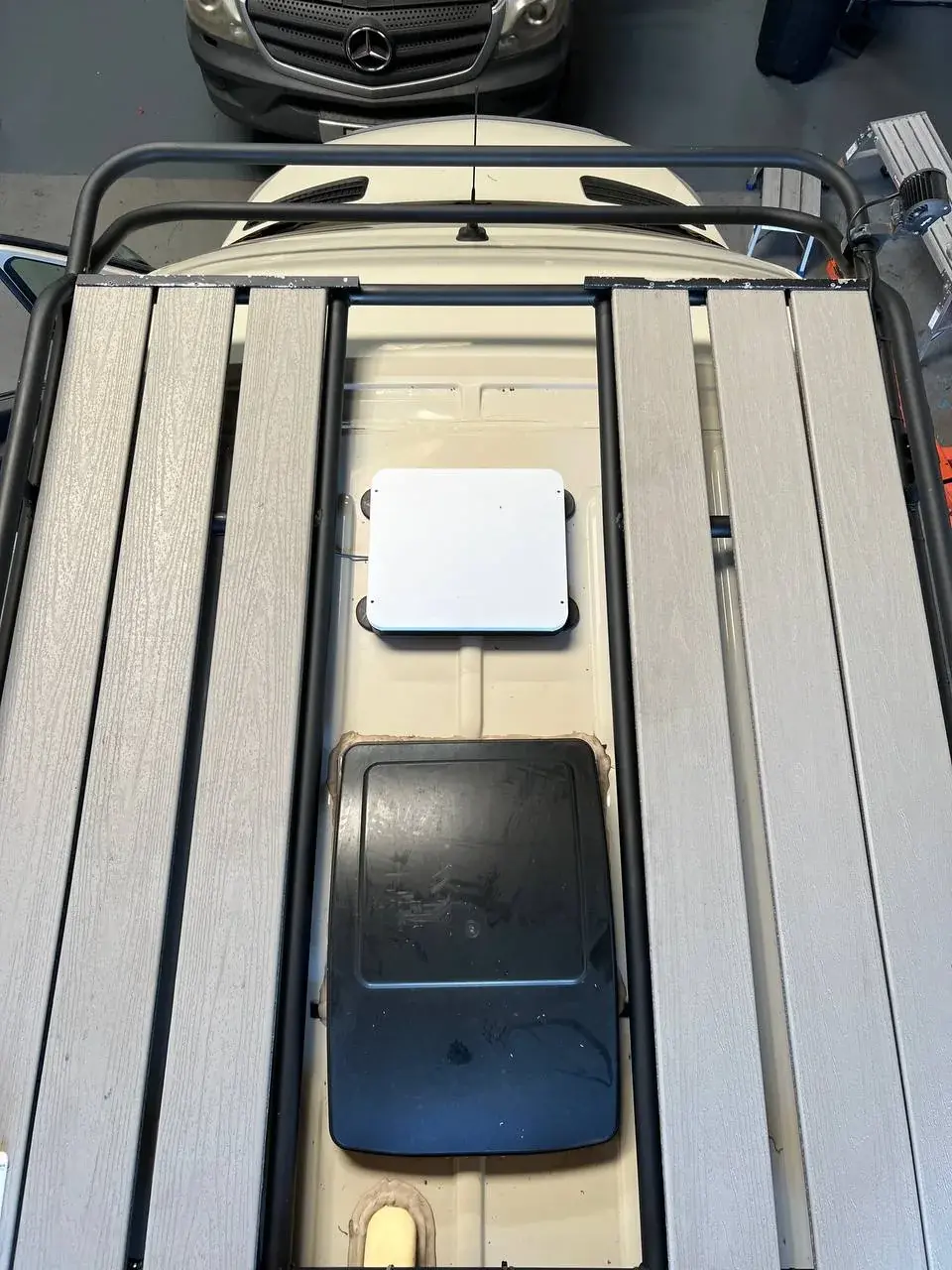
Roof layout
Where should Starlink go on a van roof?
Start with a clear view of the sky and a mounting point that suits your terminal. We look at rack rails, solar panels, roof vents, air conditioners and cargo boxes before deciding where the terminal should sit. A place that looks open from above may still be partly blocked by taller equipment beside it. The obstruction tool in the Starlink app helps assess the proposed spot.
We also check how you use the roof. A vent needs clearance to open, and gear on a deck can change the view after installation. The Starlink Mini accessories guide gives a concrete example of why the rack matters: the manufacturer lists bar dimensions for its Mini Roof Rack Mount and excludes round-profile bars.
Van fitment
What changes between Sprinter, ProMaster and Transit?
Fitment starts with the roof height, wheelbase, rails or rack, and what is already built into the van. For example, two high-roof Sprinters may have completely different mounting options if one carries a deck and the other has full-width solar. On a ProMaster or Transit, the available cable entry and access behind the headliner can be just as important as rack fit.
A fixed roof installation can save setup time if you use Starlink often. If you normally park under trees, a removable or portable setup lets you place the terminal elsewhere at camp, where it has a better view of the sky. Tell us how you camp and whether you need to remove the terminal between trips.
Cable routing and house power
How do we plan power for Starlink in a camper van?
We identify your Starlink kit first, then review whether its power supply works with your van’s existing setup. Options may include using the supplied AC adapter through an inverter or a compatible DC supply for the specific kit. We check the power source, expected run time and where you can switch the system off when it’s idle.
We plan the cable path from the terminal to the power or network equipment, keeping the connectors accessible and the cable protected from abrasion and pinching. If the layout needs a dedicated roof pass-through, we discuss its placement before cutting and check the seal and cable support after fitting. For broader electrical upgrades, see our camper van electrical installation guide.
On the road
Can you use Starlink while the van is moving?
It depends on the terminal, mount, plan and location. Starlink lists Mini, compatible Standard and Performance hardware, and eligible Roam and Priority plans in its current guidance. If you want connectivity for passengers while driving, tell us before we choose a mount and check the latest Starlink rules for where you plan to travel. Roof equipment, trees and terrain can still obstruct service. See Starlink’s in-motion requirements.
Frequently asked questions
Can I bring my own Starlink kit?
Yes. Send a photo of the label or tell us the kit model and which mount and power accessories you already have. We’ll use that information to review installation options.
Does the roof have to be drilled?
It depends on the rack, mounting hardware and cable route. Some setups can use an existing rack and cable entry. A dedicated roof pass-through may be appropriate when there is no suitable route.
Can you connect Starlink to my van’s house battery?
We can assess that option after confirming your kit and its input requirements. We’ll check the existing power system and discuss a compatible supply, cable route and shutoff.
Does a roof mount let me use Starlink while driving?
Use while driving requires compatible hardware, appropriate vehicle mounting and a service plan that permits in-motion use in your location. Check Starlink’s current requirements for your kit and plan.